
Aromatherapy at Home: Which Oils Help You Relax and Sleep
Lavender has the most evidence behind it, and a diffuser is all the equipment you need. What the studies found, and where these oils are genuinely risky.
23 July 2026 · 10 min read · By Kanchana Morasut, Licensed Thai massage therapist
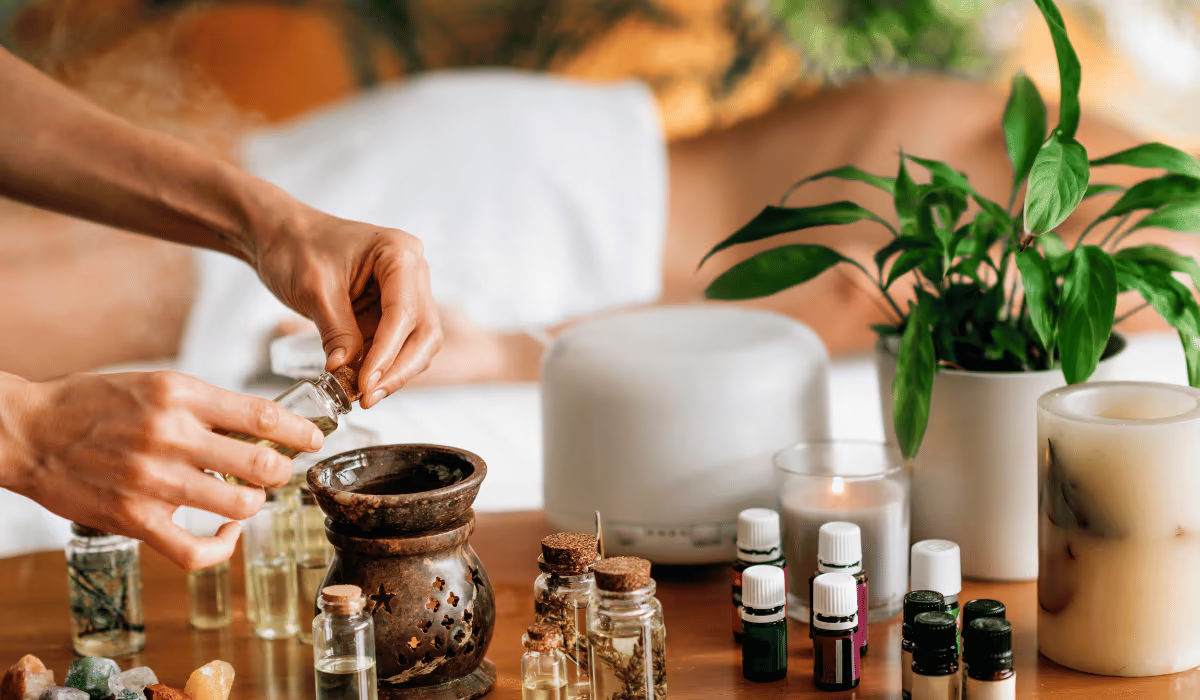
If you want aromatherapy oils for relaxation, lavender is the one to start with. It has more research behind it than any other oil. The simplest way to use it is to inhale it. Chamomile, bergamot and ylang-ylang come next. None of them will fix bad sleep on their own, and a few of them are genuinely risky if you have a cat.
- Lavender first, as the most-studied of them
- Three to five drops in a diffuser is the whole method
- Roman chamomile, bergamot and ylang-ylang as second choices
- Never swallow essential oils, and dilute anything going on skin
- Diffusing is dangerous around cats, including lavender
Start with lavender, then try chamomile
Lavender is the default for a reason. It is the most-studied oil for sleep and anxiety, and it is cheap and easy to find in Bangkok, which makes it the sensible first bottle.
Roman chamomile is the usual second pick. It is softer and slightly sweet, and people who find lavender too medicinal often prefer it. Bergamot is a citrus scent, brighter than the other two, and it suits early evening better than bedtime.
Ylang-ylang is heavier and floral. Some people love it and some find it cloying, so smell it before buying a large bottle.
Cedarwood and sandalwood are the warm, woody options. They are less studied than lavender, but they suit a bedroom well and they are a good choice if florals feel too sweet to you. Sandalwood in particular tends to read as calming rather than perfumed.
Skip peppermint and eucalyptus at bedtime. Both are stimulating, which is why they turn up in morning showers and muscle rubs. They are useful oils for other times of day.
Scent preference matters here. A smell you dislike will not relax you, whatever the research says about it. If lavender reminds you of a hospital, use something else.
The research is promising and thinner than it looks
Hwang and Shin pooled 12 trials of aromatherapy and sleep in the Journal of Alternative and Complementary Medicine, a mix of randomized and quasi-experimental studies. Sleep quality improved overall.
Their subgroup result is narrower than it is usually reported. Inhalation was the stronger method in participants who were unwell, and massage in healthy ones. The confidence intervals overlap heavily, and no direct head-to-head test was run, so treat the subgroup finding as unsettled.
The review also searched Korean databases only, up to 2013. Anything published since then is outside its scope.
Set against that, the US National Center for Complementary and Integrative Health is blunt about insomnia. We do not know whether aromatherapy helps, it says, because little rigorous research has been done. Both statements are true at once. The trials that exist lean positive, but there are few of them and the samples are small.
Treat oils as something that makes a wind-down routine more pleasant, and slightly more effective. That is a fair claim to make for them.
A small bottle takes a lot of plant
An essential oil is a concentrated plant extract. It takes a large volume of plant material to fill a small bottle. That is why a real lavender oil costs more than a synthetic room fragrance, and why the bottles are small.
That concentration is why the safety rules further down matter.
Nobody regulates the labels. Terms like "therapeutic grade" and "aromatherapy grade" sound official and mean nothing in particular, since no authority defines or awards them. A bottle can carry those words and still be mostly carrier oil.
Two checks are worth making. Look for the plant's scientific name on the label, so lavender reads Lavandula angustifolia rather than just "lavender". And look for a single ingredient, with no added fragrance or unnamed oils in the list.
Price is a rough signal too. If rose or sandalwood costs the same as a bottle of sweet orange, it has almost certainly been cut with something. Different plants yield wildly different amounts of oil, so honest pricing varies a lot between them.
Bangkok heat shortens the life of a bottle
Essential oils degrade with heat, light and air. In a climate like this one, a bottle left on a sunny windowsill or in a bathroom that steams up twice a day will turn long before its label suggests.
Dark glass is standard for a reason, so keep oils in the bottle they came in. A drawer or a cupboard away from the window is better than a shelf on display, and the fridge is fine if you have room.
Citrus oils go first. Bergamot, lemon and sweet orange oxidise faster than the florals and woods, usually within a year or so of opening. Lavender and the woody oils last longer, and sandalwood improves with age.
Trust your nose over the date on the box. An oil that has turned smells sharp, faintly like old cooking oil, and it is more likely to irritate skin at that point. Throw it out.
Breathe it in, and keep the dose small
A diffuser is the easiest method. Fill it with water, add three to five drops, and run it for twenty to thirty minutes before bed, then switch it off. The scent fades from your awareness after a few minutes anyway, so running it longer mostly wastes oil.
Without a diffuser, put one or two drops on a tissue and tuck it near your pillow. The tissue costs nothing and works about as well as a diffuser.
A warm shower works well in a Bangkok condo, where a bath is often not an option. Put a couple of drops on the shower floor away from the direct stream, and the steam carries the scent up. Ten minutes before bed is enough.
Blending is optional and easy to overdo. Two oils are plenty, and lavender with cedarwood or lavender with chamomile are the reliable pairs. Four or five oils together usually just smell muddy.
For skin, dilute first. Undiluted oil can burn or irritate. A few drops in a tablespoon of a carrier oil like coconut or sweet almond is the usual ratio.
Start the scent half an hour before you want to sleep, while you are still doing something calm. Your body then learns to associate it with winding down.
A dirty diffuser is worse than no diffuser
Water sitting in a warm room grows things. A diffuser that is topped up for a week without being emptied becomes a small humid tank, and in this climate that happens faster than the manual assumes.
Empty it after every use. Tip out whatever is left rather than leaving it to sit overnight, and wipe the reservoir dry with a cloth.
Once a week, clean it properly. Half a cup of water with a splash of white vinegar, run for five minutes, then rinsed and dried, clears the oily film that builds on the sides. That film goes rancid and it also stops ultrasonic units misting properly, which is the usual reason a diffuser seems to stop working.
Do not scrub the metal disc in the base. A cotton bud with a little alcohol is enough, and anything harder scratches it.
If anyone in the room has asthma or a dust allergy, a mouldy diffuser is a genuine health problem. Clean it or leave it off.
Where essential oils are genuinely risky
Never swallow them. Essential oils are not meant to be taken internally.
Bergamot and other citrus oils can make skin burn more easily in sunlight. If you put a citrus oil on your skin, keep that patch out of the sun for the rest of the day. In Bangkok that matters more than it does in most places.
If you are pregnant, check before you diffuse anything. Doctors advise against several oils during pregnancy. The same caution applies to the oil used in a treatment, which we cover in our guide to whether massage is safe during pregnancy.
Dr. Murl Bailey of Texas A&M College of Veterinary Medicine puts it plainly: diffused oils are very dangerous, as the oils are inhaled. Read the toxic list and you will notice the problem. Most of the calming oils are on it, lavender included. If you share a small condo with a cat, keep scent to a room the cat cannot reach, or skip it entirely.
When an oil is the wrong tool
If you are not sleeping because you are three hours short every night, no scent will close that gap. The same goes for late caffeine, a hot bedroom, or a phone in bed. Fix those first, because they matter far more than any scent.
Ongoing insomnia needs a doctor. So does anxiety that is affecting your work or your relationships. Use aromatherapy alongside whatever a doctor recommends.
And if scent gives you headaches, or you have asthma that reacts to strong smells, this whole approach is not for you. Plenty of people relax better in a room that smells of nothing.
A treatment does a different job from a diffuser
A diffuser is a nightly habit. An aromatherapy treatment is an hour where the scent is only one part of the work.
An aromatherapy massage at home uses blended oil worked into the skin, so you get the scent and the hands together. Sixty minutes is 1,200 baht, with 90 and 120 minute options on the pricing page.
If what you want is a nightly wind-down habit, buy the diffuser and skip the treatment. A massage once a month cannot do that job, and a bottle of lavender can. Book the treatment when you want the muscle work as well as the scent.
If sleep is the specific thing you are chasing, our guide to the best massage for better sleep compares the treatment types and how often to book them.
Common questions
Which essential oil is best for relaxation?
Lavender, on the current evidence. Roman chamomile is the usual alternative if you dislike the smell of it.
Do aromatherapy oils actually work for sleep?
A meta-analysis of 12 trials found aromatherapy improved sleep quality. The US NCCIH counters that the research on insomnia specifically is too thin to be sure. Expect a modest nudge.
Is it better to diffuse the oil or put it on my skin?
For everyday home use, diffusing is the simplest option and it avoids the dilution and skin-sensitivity issues entirely. A treatment is a different thing, where the scent and the hands work together.
How many drops should I use?
Three to five in a diffuser, or one to two on a tissue. More is not better, and a heavily scented room becomes distracting.
Are essential oils safe around pets?
Not around cats. Texas A&M's veterinary school warns that diffused oils are dangerous to them, and lavender, bergamot, sandalwood and ylang-ylang all appear on its toxic list. Ask a vet before diffusing around any pet.
Can I put lavender oil straight on my skin?
Dilute it first, in a carrier oil such as coconut or sweet almond. Undiluted essential oil can irritate skin or cause a reaction that makes you sensitive to it later.
Book a home massage in Bangkok
If the diffuser is not doing enough on its own, a full treatment is the next step up. A therapist works blended oil into the skin for a full hour.
A home massage in Bangkok reaches your door in 20 to 45 minutes, daily from 3 PM to 3 AM, and works on your own bed. Message us on WhatsApp or LINE to book a session.