
How Often Should You Get a Massage? A Guide for Busy Residents
The right frequency depends on your goal, not a fixed rule. Here is how often to book for stress relief, desk-bound tension, or chronic pain, and how to fit it into a busy week in Bangkok.
9 July 2026 · 6 min read · By Kanchana Morasut, Licensed Thai massage therapist
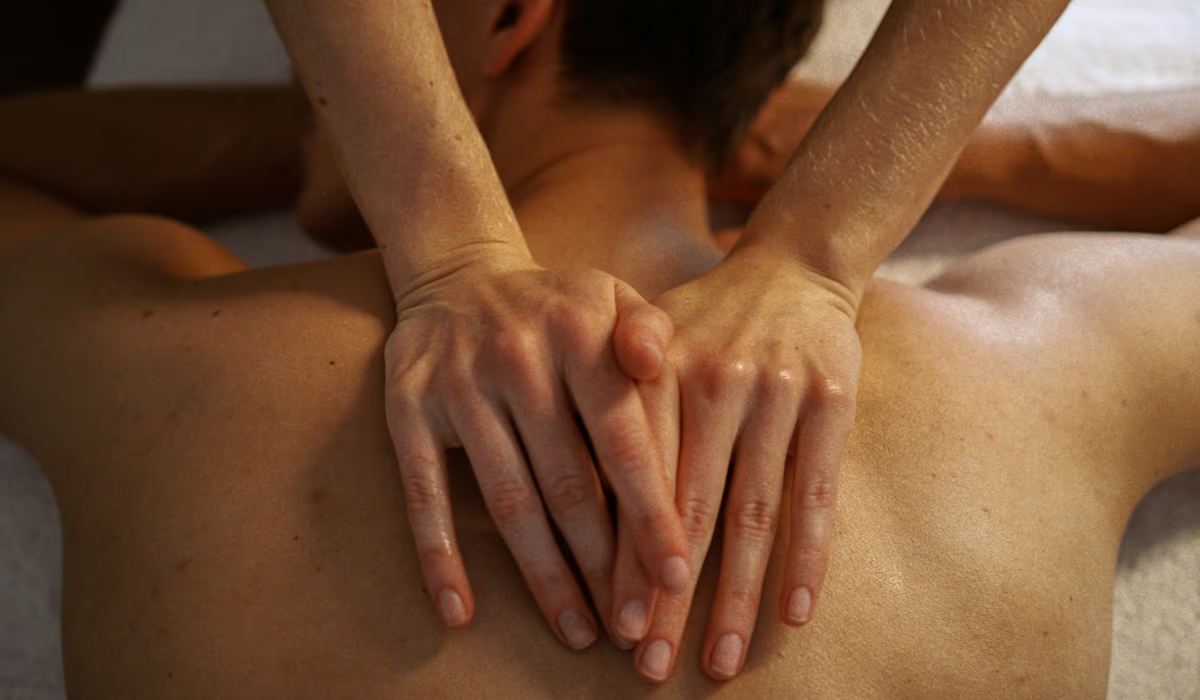
How often should you get a massage? For general wellness and stress relief, once or twice a month is enough for most people. Busy residents managing constant desk time or a stressful job often do better every two to three weeks. Chronic pain or a hard stretch of life can call for weekly sessions, then a step back to maintenance.
- General wellness and stress relief: every two to four weeks.
- Desk-bound tension and stiffness: every two to three weeks.
- Chronic pain or a hard patch: weekly for four to six weeks, then taper.
- Consistency matters more than any single session.
- A home massage removes the main reason people skip: the trip.
The short answer
Most people do well with a massage every two to four weeks. That range keeps tension from building back up without turning massage into another chore on your calendar.
Your own number depends on your goal. Relaxation and general wellness need less often than an active injury or a stressful few months at work. The sections below break it down by what you are actually trying to fix.
You will usually feel the frequency is right within two or three sessions. If tension is back within days, you are underdoing it. If you feel drained rather than loose, you are overdoing it.
For stress and general wellness
If your main goal is to unwind and keep stress from piling up, once or twice a month is usually enough. That is often enough for tension to settle before it turns into a headache or a knot between your shoulders.
Some people prefer a standing weekly appointment instead. There is nothing wrong with that if it fits your budget and your week. Stress builds gradually. The US National Center for Complementary and Integrative Health notes that regular practice tends to work better than a single occasional session.
The Cleveland Clinic is direct about this: there is no single correct frequency. It depends on your body and your goal, not a fixed rule everyone should follow.
For desk-bound tension and stiffness
Long hours at a desk, whether in an office or at home, tighten the same few spots every time: neck, shoulders, and lower back. A single massage loosens that. It rarely stays loose for a full month.
Every two to three weeks works well for most desk-bound schedules. If your shoulders creep up toward your ears by the second week, that is the signal. Move to every two weeks instead of waiting for the usual date.
A standing schedule also removes the decision fatigue of booking. You are not weighing whether you deserve it this week, you already know the answer.
For chronic pain or a hard patch
Chronic pain responds to a different rhythm. Cherkin and colleagues ran a randomized trial of 401 adults with chronic low back pain in the Annals of Internal Medicine (2011). Patients got ten weekly one-hour massages. More than one in three said their pain was much better or gone, against one in twenty-five in the usual-care group. The improvement was still measurable six months later.
That is the pattern worth copying: a short run of weekly sessions, not one massage repeated forever at a wide interval. Once the pain eases, space sessions out to every two or three weeks to hold the gain.
Consistency beats a single big session
One long, deep massage feels great for a day or two, then fades. A shorter session, repeated on a schedule, tends to hold its benefit longer. We covered the research on this when comparing home massage and spa visits for a regular routine. Twice-weekly sessions moved stress hormones more than once-weekly ones did.
The practical version: pick a frequency you can actually keep for two months, even if it is lighter than what sounds ideal. A realistic schedule you stick to beats an ambitious one you abandon after three weeks.
Fitting it into a busy week in Bangkok
The biggest reason people fall off a massage routine is not cost. It is the trip: getting to a spa, waiting, then getting home again on top of an already long day.
A home massage in Bangkok removes that step. The therapist arrives at your door in 20 to 45 minutes and works on your own bed. When the session ends, you are already home. That is usually the difference between a routine that survives a busy month and one that quietly stops in week three.
Budget matters too. See pricing for every treatment and length, including deep tissue massage at home for tighter, more stubborn spots. A lighter, more frequent schedule at a lower price point often beats one expensive splurge a quarter.
When to slow down or skip a session
More is not automatically better. If you feel sore, bruised, or drained for more than a day after a massage, that is a signal. You are booking too often, or too hard, for your body right now.
Skip or delay a session if you are feverish or have an open wound near the treatment area. The same goes for any health condition your therapist has not been told about. A single relaxing massage now and then is a perfectly fine routine too. Not everyone needs a fixed schedule.
Common questions
How often should I get a massage for stress relief?
Once or twice a month covers most people. If your job is unusually stressful right now, every two weeks works better until things settle.
Is one massage a month enough?
For general wellness and light stress, yes. For chronic pain, an active injury, or heavy desk strain, monthly is usually too infrequent to keep the benefit.
Can you get a massage every week?
Yes, and for a short run during a pain flare or a hard stretch of life, weekly is often the right call. Long term, most people taper to every two or three weeks once things improve.
How often should I get a massage for back pain?
Weekly for four to six weeks is a common, well-studied starting point, then space sessions out as the pain eases.
How often should I get a massage for better sleep?
See our guide to massage for better sleep for the specific frequency that supports sleep, which differs slightly from general stress relief.
Can you get a massage too often?
Yes. Ongoing soreness, bruising, or fatigue after sessions is a sign to slow down, not push through.
Book a home massage in Bangkok
Whatever frequency suits you, a home massage makes it easier to keep. A licensed therapist comes to your home or condo in 20 to 45 minutes, daily 3 PM to 3 AM, and works on your own bed.